
A stylish name generator cannot restyle Urdu, Hindi or Bangla letters — it can only decorate around them. We put the Urdu name راحیل through our own tool on 17 October 2026 and got 10 results back: all 10 kept the spelling exactly right, and all 10 differed from what we typed in some way — 5 to 10 of them being distinct within one request, depending on the draw, out of a decoration pool that tops out at 10. The same name in Devanagari (राहुल) and Bangla (রাহুল) returned the same counts, and a re-run on the same date returned them again. For comparison, the Latin spelling Rahul came back with 102 of 110 results changed. The ten results you see for an Urdu or Hindi name are the complete set — nothing padded, nothing missing.
Measured on this site’s own generator on and re-measured over 200 consecutive runs the same day; the engine’s own style table was read on that date. Type your own name in the box above to reproduce it.
What we measured, and how
We sent five names through the live generator — the same public endpoint the box at the top of this page uses — and compared every returned variant against the exact string we typed, code point by code point. Two questions, asked separately, because they have different answers:
- Is the spelling intact? Do all the original characters still appear, in the original order, nothing inserted between the letters and nothing dropped?
- Did anything change at all? Is the result a different string from the input, or is it identical?
Most pages in this category only ever answer the first question, which is how “supports Urdu” ends up meaning two completely different things. Answering both is the point of this page.
The result, script by script
Here is the whole measurement. “Spelling intact” counts results where every original character survived in order; “different from input” counts results that are not simply the name handed back.
| Input | Script | Results | Spelling intact | Different from input | Distinct decorated, whole pool |
|---|---|---|---|---|---|
| راحیل | Urdu (Arabic script) | 10 | 10 | 10 | 10 |
| राहुल | Hindi (Devanagari) | 10 | 10 | 10 | 10 |
| রাহুল | Bangla | 10 | 10 | 10 | 10 |
| أحمد | Arabic | 10 | 10 | 10 | 10 |
| Rahul | Latin | 110 | 75 | 102 | 130 |
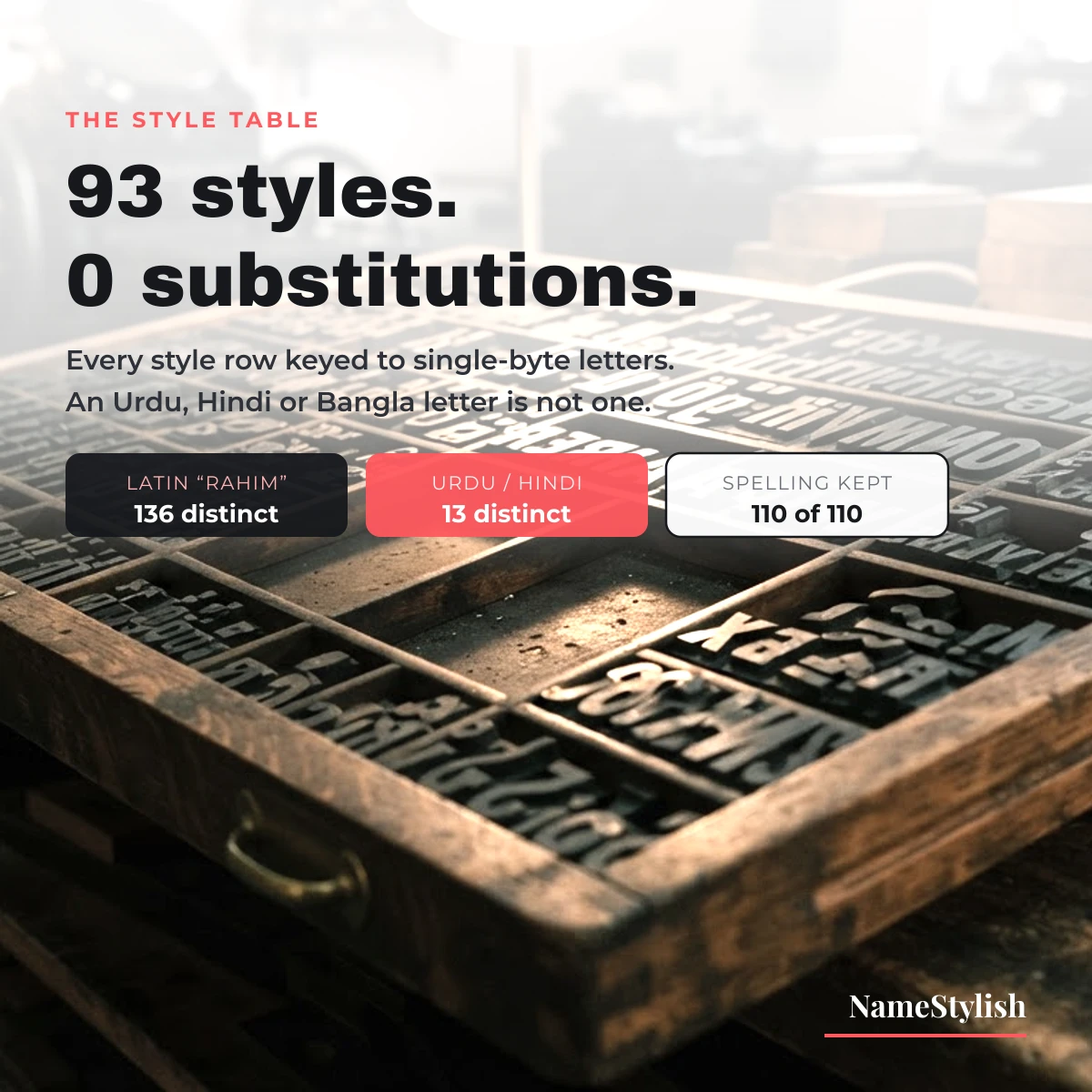
Read the Latin row against the others and the shape of the tool becomes clear. For Latin it is a restyler: 35 of 110 results replace the letters with characters from another alphabet, so the spelling is no longer “intact” in the strict sense used here — that is the whole point of those styles. For Urdu, Hindi, Bangla and Arabic it is a framer: the letters are never touched, and only the frame changes.
This is the complete decorated set for راحیل — all 10 of them, exactly as the tool returns them, collected by running the generator 200 times over. A single request shows you five to ten of them, repeats included; nothing you can do will produce an eleventh, because there are only 10.
Why the letters come back untouched
The reason is in the engine, not in your keyboard. Each style is a lookup table that maps one character to its styled replacement, and the code reads the input one whole character at a time, applying a swap only where that character is one of the 52 plain Latin letters the table covers.
An Urdu, Devanagari or Bangla letter is never one of those 52 Latin letters, so it is never a key in the table and passes straight through without a swap — which is also exactly why it cannot be corrupted. The only part of a style that can still attach itself is the decoration some styles wrap around the whole name, and those decorated rows are the only ones that come back for a non-Latin name: a row with nothing to add is left out rather than returned as a copy of the plain name.
There is a second, deeper reason this is unlikely to change soon. The styled alphabets almost every generator uses come from the Unicode block Mathematical Alphanumeric Symbols, and that block contains Latin and Greek letters and digits. There is no bold Urdu alphabet or cursive Devanagari alphabet in Unicode to map to, because those scripts express weight and style through typefaces, not through separate characters. A generator cannot hand you a character that does not exist.
Worth knowing alongside that: even for Latin, the styling is fragile. Those mathematical letters carry a compatibility decomposition, so any system that applies NFKC normalisation turns 𝐑𝐚𝐡𝐮𝐥 back into Rahul — the rule is set out in UAX #15, and we counted how many of our styles it takes down in what normalising does to a fancy font. Urdu and Hindi names simply skip that failure mode entirely, because there was never any styling on them to strip.
The good news: your spelling is safe
The negative result has a genuine upside, and it is the reason this page exists rather than a vaguer one. Across all four non-Latin scripts we tested, 10 of 10 results kept the original characters in the original order: no Urdu letter was separated from the next, no Devanagari matra was detached from its consonant, no Bangla conjunct was broken apart. Nothing was inserted between the letters.
That matters because the failure mode people actually fear with these scripts is not “my name was not styled” — it is “my name was mangled and now it reads as something else”. A tool that cannot touch your letters cannot misspell them either. If you want a decorated Urdu or Hindi name, frame it; if you want a restyled one, the honest answer is to use the Latin transliteration, and both shelves are below. For a much larger set of framed Urdu names and phrases — شہزادی, سکون قلب, انت الحیات — with frames checked to face the right way, see the Urdu stylish name page.
Stylish fonts and fancy fonts: the words are doing the wrong job
Neither “stylish fonts” nor “fancy fonts” describes what a name generator hands you, and for Urdu and Hindi that mismatch is the whole story: there is no font involved at any point, so there is nothing that could be swapped for a styled version of your script.
What a stylish font really is
A font is a file installed on the device doing the displaying — Nastaliq for Urdu, a Devanagari face for Hindi — and a website cannot reach into your phone and change it. What the box at the top of this page returns is not a font but characters: ordinary Unicode text you copy and paste, which every app then draws in whatever font it already uses. That is why a styled name keeps working after you paste it, and also why the style travels with the text instead of with the app.
For Latin letters that distinction is invisible, because Unicode happens to contain look-alike alphabets — mathematical bold, italic, double-struck, monospace — that a generator can substitute letter for letter. Urdu, Devanagari and Bangla have no such duplicate alphabets in the standard. So “stylish fonts in Urdu” has no object: the styled letters it asks for were never encoded, by anyone, anywhere.
Are fancy fonts real fonts?
No — fancy fonts are plain Unicode characters wearing a misleading name, and they behave like text, not like typography. Three consequences are worth knowing before you use one:
| Question | Answer | What it means for an Urdu or Hindi name |
|---|---|---|
| Do you install anything? | No | Nothing to install means nothing is missing on your side — the plain result is the honest one |
| Which fields accept it? | Display name, bio, in-game name | The same fields accept a framed Urdu name, since a frame is text too |
| Which field refuses it? | An @username or handle | Handles are restricted to letters, digits, dots and underscores by design |
| Does search see the styling? | No — it is normalised away | Of our 93 styles, 12 revert to the exact plain spelling, 1 reverts in capitals, 2 turn into different text and 78 come through untouched |
| Can it change your spelling? | Only if letters were substituted | Urdu, Hindi and Bangla letters are never substituted, so this risk does not apply |
Read the last two rows together and the position of a non-Latin name becomes clear rather than disappointing. The styles that a search box strips are exactly the ones that replaced your letters; the decorations available to Urdu and Hindi sit in the 78 that survive normalising untouched. You are not getting a lesser result — you are getting the durable half of the set.
Why the counts differ from run to run
The generator hands back 10 slots on every single request for a non-Latin name, but it draws those slots at random from three overlapping sections, so two people measuring the same Urdu name can still see different numbers of genuinely distinct strings even though the slot count never moves. We ran it 200 consecutive times on 17 October 2026 to pin down which figure is which.
| What is counted | Figure | Why it comes out that way |
|---|---|---|
| Results returned per request | 10 | A fixed number of slots, the same on all 200 runs |
| Results that differ from the input | 10 | All of them: a row with nothing to add is left out rather than returned |
| Distinct decorations in one request | 5–10 | The ten are drawn with repeats allowed across three sections, so some runs show duplicates |
| Distinct decorations in the whole pool | 10 | Reached within the first few dozen runs, and it never grows past this |
| Letters changed, any run | 0 | No styled Urdu or Devanagari alphabet exists to change them to |
| Same pool for the Latin spelling Rahul | 130 | Latin letters match the style rows, so every style adds a new result |
That single table settles the numbers that look contradictory in the wild. 10 is how many results you see for a non-Latin name, and also how many different strings exist in the whole pool — the figure we published on the imo name page after repeated passes over a Bangla name. Five to ten is what any one request shows you as genuinely distinct, since the ten slots are drawn with repeats allowed. The number that never moves, on any run and in any script, is the one that matters: zero letters changed.
The two-word trap: the space disappears
If your name is two words, every one of the 93 styles deletes the space between them, and for Urdu or Hindi that is the one change the tool does make to your text. We put راحیل احمد through all 93 styles on 22 September 2026: all 93 returned راحیلاحمد — ten characters in, nine out, two words joined into one. The letters are still correct; the word boundary is not.
It happens to Latin names too, it is just easier to forgive there: Rahil Ahmad comes back as ʀᵃʰⁱˡᴀʰᵐᵃᵈ, styled and closed up. On Urdu, Hindi or Bangla text there is no styling to distract from it, so the joined words are the only thing you notice.
The fix, tested on all 93 styles: type a no-break space between the two words instead of a normal one. A normal space (U+0020) survived 0 of 93 styles; a no-break space (U+00A0) survived 93 of 93, so the gap stays exactly where you put it. It is the same character that holds a gap open in a game name box — our list of blank characters that actually work has it ready to copy.
How to check any styled name before you keep it: paste it into your phone’s notes app and read your own name inside it, letter by letter. If the spelling is right there, it is right — the decoration is the only part that can look different elsewhere.
Frames and ornaments that work with any script
Since framing is what actually works, here are frames chosen for it. Everything in the first two groups is direction-neutral or a matched mirror pair, which is what a right-to-left script needs; the group after that shows real Urdu, Hindi and Bangla names already framed, with the spelling untouched.
Mirror-pair frames — safe on right-to-left text 14
Each of these is a matched pair: the same shape mirrored, so it reads correctly whichever direction the script runs. Put one on each side of your name and the Urdu or Hindi spelling inside stays untouched.
Single ornaments that carry no direction 22
Stars, moons, flowers and hearts have no left or right about them, which makes them the least risky thing to put beside a script that runs the other way. One character each.
Kaomoji — and why they sit outside the name 12
A face built from brackets does have a direction, so it belongs at one end of the name rather than wrapped around it. Placed after an Urdu name it reads as a separate ornament, which is the intended effect.
Dividers for a bio line in any script 26
These go above or below a name rather than around it, which side-steps the direction question entirely. Useful in a bio, too long for a name box.
Framed Urdu, Hindi and Bangla names — spelling untouched 24
This is the whole of what the tool can honestly do with a non-Latin name, so here it is done properly: a real name, spelled correctly, with a frame around it. Nothing inside the frame has been altered by a single character. Tap one to copy it, or type your own name in the box at the top and put a frame from the shelves above around the result.
The workaround: style the Latin spelling instead 18
If what you actually want is a restyled name rather than a framed one, type the Latin transliteration. Every one of these is the same name written in Latin letters and then put through a style that does transform — which is the only route to a genuinely different-looking name for now.
FAQ
Why does the generator only return a handful of results for my Urdu name?
Because most styles in the table are letter-substitution styles, and they have nothing to substitute: the table only covers plain Latin letters, so a style with no Latin letter to work on has nothing to add and is left out rather than returned as a copy of your plain name. What is left is the ten results that actually wrap a decoration around the name; five to ten of those ten are distinct on any given run, out of a pool of ten in total.
Is there any stylish font for Urdu or Hindi?
Not as copyable text. Unicode has no bold, cursive or double-struck Urdu or Devanagari alphabet to copy from — those scripts carry weight and style in the typeface, which is a property of the app displaying the text and not of the text itself. What you can copy is a frame or an ornament around the correctly spelled name.
Will a styled Urdu name break the spelling or reverse the letters?
Not in our measurement: 10 of 10 results kept every character in order, for Urdu, Arabic, Devanagari and Bangla alike. Right-to-left display is handled by the app you paste into, and since the letters themselves are unchanged, they join and flow as they normally would.
So how do I get a name that actually looks styled?
Type the Latin transliteration — Rahil, Ayesha, Rahul, Anaya — and the full set of styles applies to it, because Latin letters are what the style table maps. The transliteration shelf above has ready-made examples, and you can always keep the script spelling in your bio and the styled Latin one as your display name.
Why did my two-word Urdu name come back as one word?
Because all 93 styles strip a normal space out of the name, which on Urdu or Hindi text is the only edit any of them makes. Type a no-break space between them instead — measured on 22 September 2026, it survived all 93 styles while a normal space survived none.
Does the decoration count towards a name length limit?
Yes, and so does every mark inside it. A frame is typically two to six characters on top of your name, which is enough to fail a tight game name box on its own — we counted the cost of every style in how long a stylish name really is.
If a framed name arrives at the other end as hollow squares rather than ornaments, that is a font-coverage problem on the reading device rather than anything to do with your script: what the empty box actually means explains it, and which symbols survive a name field ranks decorations by how likely each kind is to come back unchanged. For everything else, the NameStylish stylish name generator at the top of this page is the same engine we measured here — and the imo name style page covers the app where Bangla and Urdu display names come up most often.
NameStylish is an independent tool. It is not affiliated with, endorsed by, or sponsored by Garena / Free Fire, Moonton / Mobile Legends, PUBG / BGMI, imo, Yalla, Hago or Meta / Instagram. All product names are trademarks of their respective owners; all styled characters come from the public Unicode standard.