
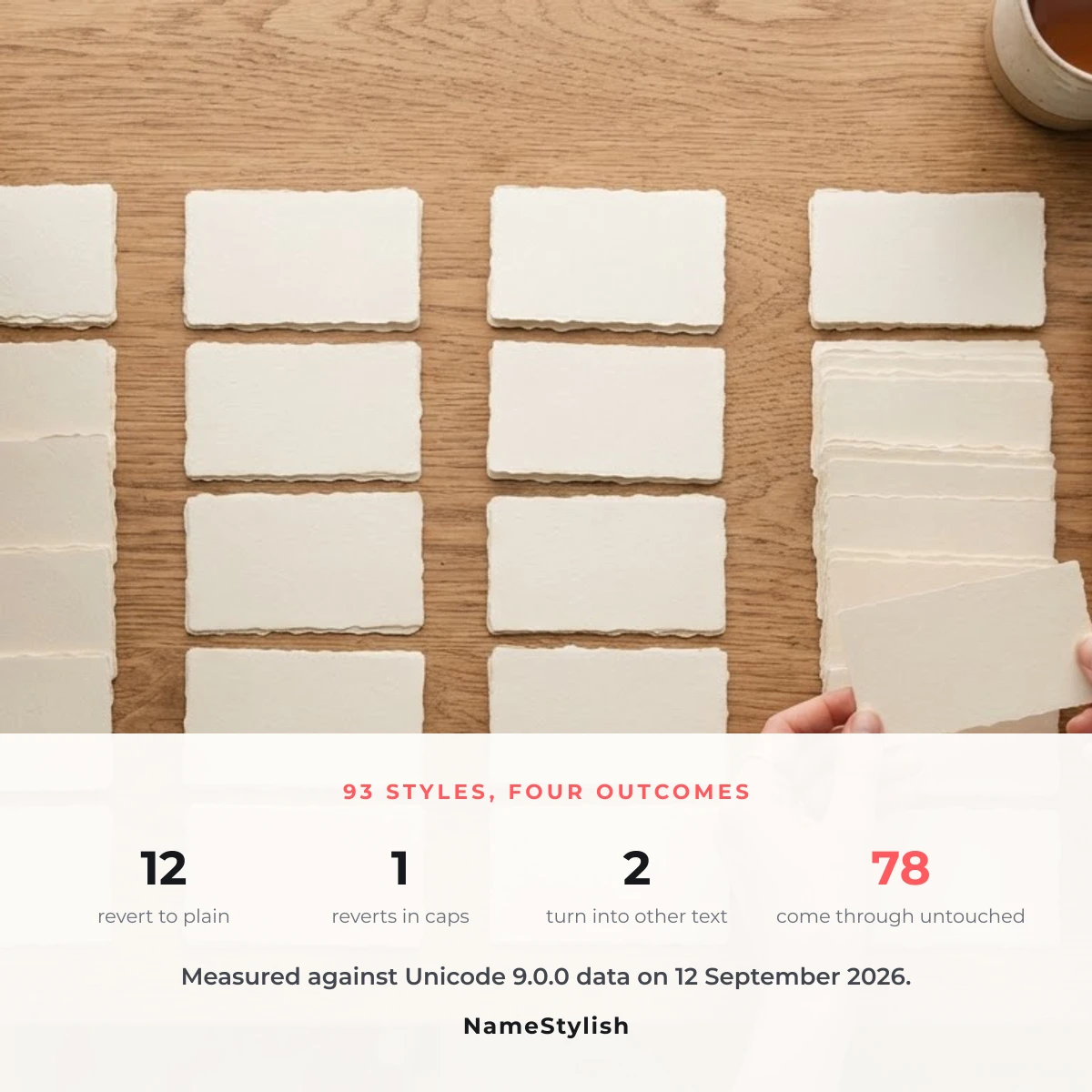
A “fancy font” is not a font. It is ordinary text made of unusual Unicode characters — 𝐑𝐚𝐡𝐮𝐥 is five characters that happen to look bold, not the word Rahul with bold applied to it. That distinction is not pedantry: it decides where a styled name works, and whether it survives being saved. We put all 93 style rows in our own generator through Unicode normalisation on 12 September 2026 and counted the outcome: 12 turned straight back into plain text, one came back in capitals, two turned into something else entirely, and 78 came through untouched.
Normalisation measured with Python’s Unicode 9.0.0 character data on , against styles generated by this site’s own engine. Type a name in the box above to see the styles being discussed.
The short answer
No font is involved anywhere in the process. When a generator gives you 𝓡𝓪𝓱𝓾𝓵, it has replaced each letter with a different character that already exists in the Unicode standard — in this case from the block called Mathematical Alphanumeric Symbols, which exists so that mathematicians can write a bold vector and an italic variable as distinct symbols rather than as formatting.
That is why a styled name pastes into an app that never offered you a font picker: you are not sending formatting, you are sending characters. It is also why the effect can be undone in a way that real formatting cannot be, and why some of it looks like empty boxes on a device whose fonts do not cover those characters.
Why it cannot be a font, technically
A font is a file on the device doing the displaying. If a name field rendered your name in a decorative typeface, that typeface would have to be installed on every phone that displays it — which is exactly why apps let you choose a font for your interface and never for your name as other people see it.
Unicode side-steps that by making the styling part of the text. The trade-off is stated in the standard itself: because these characters are variants of ordinary letters rather than new letters, most of them carry a compatibility decomposition — a documented instruction that says “this character is equivalent to that plain one”. Any system that runs NFKC normalisation follows those instructions, and the styling disappears. The rules are set out in UAX #15, Unicode Normalization Forms.
Systems normalise for good reasons: so that a search for “Rahul” finds 𝐑𝐚𝐡𝐮𝐥, so that two accounts cannot register visually identical names, and so that a username is comparable to every other username. Nothing is broken when it happens. It is the standard working.
Measured: what normalisation does to 93 styles
We generated the name Rahul in every one of our 93 style rows and normalised each result, comparing it both to the plain name and to its own canonical form so that an invisible reordering of marks does not get counted as a change. Four outcomes, and they are very unevenly distributed.
| Styles | Outcome | Which ones | Example |
|---|---|---|---|
| 12 | Reverts to the exact plain name | Bold, Italic, Bold italic, Italic handwriting, Double letters, Classic and Art (fraktur), Thin letters, Circle, Wide font — plus one row that was never styled to begin with | 𝐑𝐚𝐡𝐮𝐥 → Rahul |
| 1 | Reverts, but in capitals | Square border | 🅁🄰🄷🅄🄻 → RAHUL |
| 2 | Turns into different text | Small text, Bracket | R⒜⒣⒰⒧ → R(a)(h)(u)(l) |
| 78 | Comes through untouched | Every combining-mark decoration, plus the styles built from other writing systems | 卂ㄚ乇丂卄卂 |
The Bracket row is the one worth pausing on, because it fails in the least expected way. Its parenthesised letters ⒜⒣⒰⒧ decompose into literal parentheses, so a name that looked like R⒜⒣⒰⒧ when you copied it saves as R(a)(h)(u)(l). It did not lose its styling. It gained punctuation.
The practical version of all this: if you want a styled name to still look styled next week, do not build it out of a bold or cursive alphabet. Build it out of a plain name plus symbols — symbols have no plain letter to fall back to.
The style that half survives
Small caps is the style usually described as the one that survives normalisation, and our measurement shows why that is only half right. Small-capital letters live in the Latin Extended and IPA Extensions blocks, where they are treated as genuine letters for writing phonetics rather than as styled variants — so they carry no compatibility decomposition and nothing strips them.
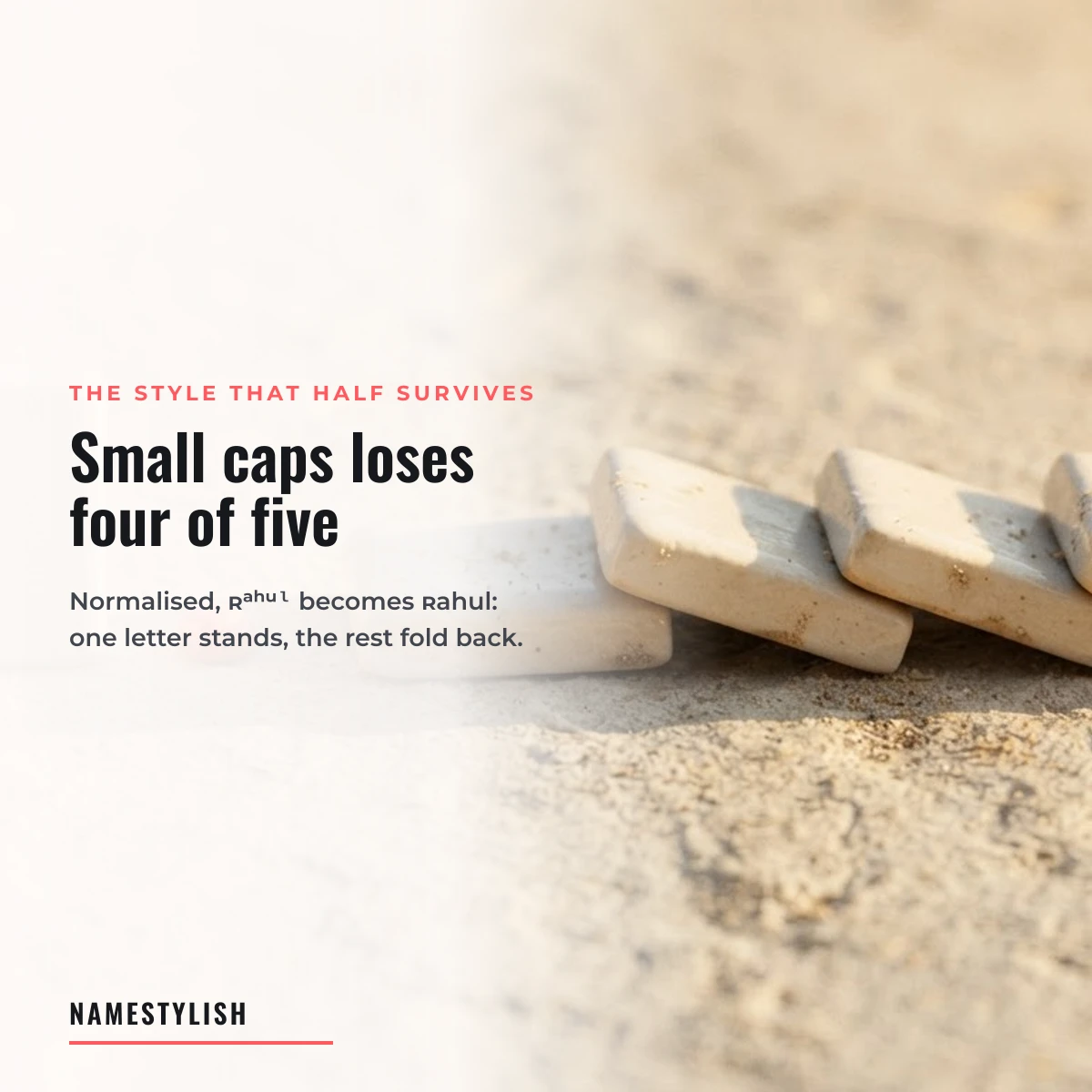
The catch is that the set is incomplete, and generators fill the gaps with superscript modifier letters, which do decompose. Our Small text row renders Rahul as ʀᵃʰᵘˡ: one real small capital and four modifier letters. Normalised, it becomes ʀahul — the first letter survives and the rest fall back to plain. One letter of five.
So “small caps survives” is true of the letters that exist as small capitals and false of the ones borrowed to fill in for the rest. Whether your particular name survives depends on which letters are in it — which is not a satisfying answer, but it is the accurate one.
Where styled text is accepted, and where it is not
Because it is text rather than formatting, acceptance is decided field by field rather than app by app. The pattern is consistent enough to state as a rule:
| Kind of field | Styled Unicode | Why |
|---|---|---|
| Display name, profile name | Accepted | Free text, shown to other people as stored |
| Bio, about, status | Accepted, and roomiest | Free text with a generous length limit |
| In-game name | Usually accepted | Free text, but filtered and short — symbols are refused more often than letters |
| @username or handle | Refused | Restricted by design to letters, digits, dots and underscores so handles stay comparable |
| Anything searched or matched | Accepted, then normalised | The field stores it; the comparison strips it |
One more hazard that is specific to how these characters work rather than to any app: the style built from regional-indicator letters turns pairs of letters into flags. The name samir in that style comes back as 🇸🇦🇲🇮🇷 — which your device reads as the flag of Saudi Arabia followed by two letters, because that is what those code points mean when they sit next to each other. It is not a bug in the generator; it is what the characters are for.
Decorations that cannot be normalised away
Everything below is chosen on one criterion: it is not a letter in disguise, so normalisation has nothing to convert it into. A plain name wrapped in these is the most durable styled name you can build.
Symbols — nothing to normalise away 52
A star is not a styled letter, so there is no plain letter for it to fall back to. Normalisation leaves these exactly as they are, which makes a decorated plain name the most durable kind of styled name there is.
Frames that hold their shape 6
Bracket ornaments from the Javanese, Tibetan and Mathematical blocks. None of them is a letter in disguise, so none of them decomposes into one.
Kaomoji — punctuation, not letters 12
Faces are built from brackets, dots and marks. Every part is already its own character, which is why a face comes through a normalising field intact while a bold alphabet does not.
Dividers and trails 22
Longer ornaments for a bio line. Same reasoning: symbols all the way through, so nothing to strip.
The styles that survive — and the catch 15
These use letters borrowed from other writing systems — Cherokee, Canadian Aboriginal, Yi, Javanese and Thai-lookalike sets — and that is exactly why normalising leaves them alone: they are not styled Latin letters, so there is no plain Latin letter for them to fall back to. The catch is that a name spelled in borrowed letters is the same shape as a name spelled to dodge a word filter, so keep the wording clean and read what actually gets a name actioned first. A plain name with symbols around it is the safer durable option.
FAQ
Do I need to install a font to use these?
No, and there is nothing to install. You are copying characters, not formatting, so they travel with the text into any app. What the receiving device does need is a font that covers those characters — and when it does not, you get an empty box instead.
Why did my styled name turn back into plain letters after I saved it?
The field normalised it. Twelve of our 93 styles revert to the exact plain name under NFKC, because the characters they use are documented as equivalent to ordinary letters. Nothing was lost or broken; the standard was applied. Pick a style from the surviving set, or decorate a plain name with symbols instead.
Which fancy font style lasts the longest?
A plain name with symbols around it, every time. After that, the styles built from other writing systems survive normalising — with the caveat in the shelf above about borrowed letters. The bold and cursive alphabets are the prettiest and the least durable.
Is small caps really the only style that survives?
Partly. Real small capitals survive because they are letters in their own right, but the small-caps alphabet is incomplete and the missing letters are usually filled in with superscript letters that do not survive. Our Small text row keeps one letter of five after normalising.
Can I use a fancy font in my @username?
No. Handles are restricted to plain letters, digits, dots and underscores by design, so that one handle can be compared reliably against every other. The display name beside it accepts styled text without complaint, which is why most people style that instead — the Instagram name style page has ready-made ones and counts them against the 30-character name field.
Two things follow from all of this and both have their own page. Length: styled characters are counted, and the marks you cannot see are counted too — we measured what each of the 93 styles costs. Rendering: a character your friend’s phone has no glyph for arrives as a hollow square, which is a font-coverage problem rather than a broken name. And if your name is written in Urdu, Hindi or Bangla, none of the alphabets above applies to it at all: there is no bold Devanagari in Unicode to copy. Everything here runs on the NameStylish stylish name generator at the top of this page.
NameStylish is an independent tool. It is not affiliated with, endorsed by, or sponsored by Garena / Free Fire, Moonton / Mobile Legends, PUBG / BGMI, imo, Yalla, Hago or Meta / Instagram. All product names are trademarks of their respective owners; all styled characters come from the public Unicode standard.