
An Urdu stylish name is a name or phrase written in correct Urdu script and decorated around the outside — ༺ شہزادی ༻ or ★ سکون قلب ★ — because Urdu letters themselves cannot be swapped for a fancy alphabet the way English letters can. Copy one of the 107 framed names below, or type your own into the box above. Everything here keeps the spelling exactly as written and uses only frames that sit correctly around right-to-left text, which matters more than it sounds: some of the most popular frames are not mirrored for Urdu and end up the wrong way round.
Urdu spellings checked by hand; frame direction measured from Unicode character data on . NameStylish is independent and not affiliated with any app named here.
Urdu stylish name maker: what it changes and what it leaves alone
An Urdu stylish name maker decorates; it does not restyle. Type a name into the box at the top of this page and the generator wraps frames and ornaments around it — free, with no sign-in and nothing to download — but it never swaps an Urdu letter for a different-looking one, because no styled Urdu alphabet exists to swap it for.
That single sentence is the difference between this page and most pages promising “1000+ Urdu fonts”. A stylish name in Urdu is your own spelling, correct and unaltered, inside a decoration. We measured it on our own engine on 22 September 2026: a single-word Urdu name comes back from all 93 style rows identical to what was typed, and the whole decoration pool for it holds 12 frames. Nothing is broken — there is simply nothing in the standard for those rows to apply.
| What people ask for | What you actually get |
|---|---|
| Fancy Urdu letters, like bold or cursive English | Not possible — those letters were never encoded. Your spelling stays as typed |
| A frame or ornament around an Urdu name | Yes, and it is the whole craft of this page: 107 hand-checked ones below |
| An English name written in Urdu script | Yes — the transliteration shelf further down has them ready to copy |
| Something to install first | Nothing. Every name here is text: each letter of شہزادی, سکون قلب, داستان عشق and جٹ sits in Unicode’s Arabic block, U+0600 to U+06FF |
| A two-word Urdu name | Type a no-break space between the words. A normal space is removed by all 93 styles; a no-break space survived all 93 |
شہزادی and royal Urdu stylish names
شہزادی (Shehzadi, princess) is the most searched Urdu stylish name by a wide margin, and its twin شہزادہ (Shehzada, prince) follows it. Royal words suit heavier frames and a crown mark.
Love and sorrow phrases in Urdu
After the royal names, most Urdu display names are short phrases rather than names: انت الحیات (you are life, borrowed from Arabic), سزائے عشق (the punishment of love), ادھورا عشق (unfinished love), سکون قلب (peace of the heart), جاناں (beloved). Each is shown in three frames so you can pick the weight.
Roman spellings: what to type when you cannot type Urdu
Most people searching for these names type them in Roman letters, because a phone keyboard set to English cannot produce Urdu script. This table is the bridge: find the Roman spelling you know, copy the Urdu one beside it.
| You type | Urdu script | What it means |
|---|---|---|
| Shehzadi, shahzadi | شہزادی | Princess — the most searched of them all |
| Shehzada, shahzada | شہزادہ | Prince |
| Malika | ملکہ | Queen |
| Saza e ishq, saza-e-ishq | سزائے عشق | The punishment of love |
| Dastan e ishq, dastaan e ishq | داستان عشق | A story of love |
| Sukoon e qalb, sukun e qalb | سکون قلب | Peace of the heart |
| Antal hayat, anta al hayat | انت الحیات | Arabic for you are life, used in Urdu-script display names |
| Jutt, jatt | جٹ | A Punjabi clan name, worn as a surname in a display name |
جٹ — Jutt stylish names in Urdu
Jutt is the one entry here that is a clan name rather than a word, and it behaves exactly like any other Urdu name in the generator: the two letters جٹ come back untouched and only the frame around them changes. These are all 11 frames the tool produces for it, minus the one this page warns about further down.
Written the Roman way, Jutt is a Latin word, so the full style table applies to it and you get substituted letters rather than frames. A selection of what comes back:
English names written in Urdu
“English to Urdu stylish name” is really two jobs, and a generator only does one of them. It cannot transliterate — turning Sara into سارہ is a spelling decision, not a style — but once you have the Urdu spelling it can frame it, and it can fully restyle the English spelling. So each name below comes both ways: the Urdu spelling framed, and the English spelling in a styled alphabet.
Why the Urdu version is framed rather than restyled, measured on our own tool, is set out in what a stylish name generator can and cannot do to Urdu and Hindi.
Frames that face the right way around Urdu
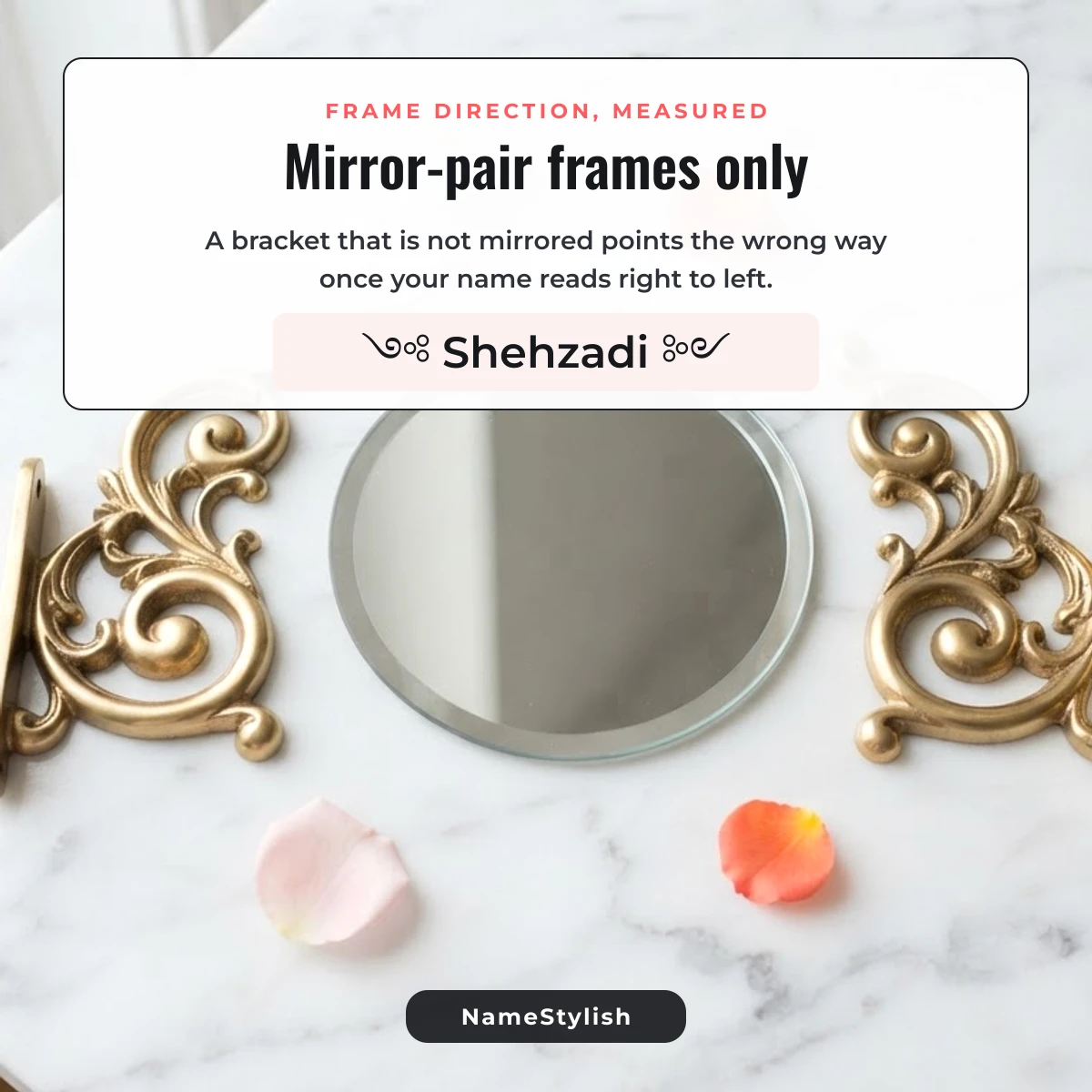
A frame character does not know which language it is next to, but the text engine does. In right-to-left text, characters with the Unicode Bidi_Mirrored property are drawn flipped so an opening bracket still opens towards the word. Characters without it are drawn as they are — so a frame designed for English can land on the wrong side of an Urdu name.
| Frame | Mirrored in right-to-left text? | Around an Urdu name |
|---|---|---|
| ༺ ༻ | Yes | Safe |
| 「 」 『 』 【 】 | Yes | Safe |
| ⟦ ⟧ ❪ ❫ « » ⊰ ⊱ | Yes | Safe |
| ★ ✦ ❀ ♡ ━ ╬ | No — but symmetric | Safe, looks the same either way |
| ꧁ ꧂ | No | Can land on the wrong side |
| ⎝ ⎠ ↞ ↠ | No | Can land on the wrong side |
Every frame used in the Urdu names on this page is from the safe rows. Here they are on their own, to put around a name of your choice:
Two decorations to avoid in an Urdu name
Two things that turn up in copied Urdu nicknames are not decoration at all. U+06DD, the Arabic end-of-ayah mark, and U+FDFD, the Bismillah ligature, are both scripture characters, and using them to decorate a nickname can offend. And patterns built from Urdu letters, such as ٨ہ, are letters: ہ joins to the letter beside it, so placed against an Urdu word it can merge into the word instead of framing it. Keep letter-based patterns for English words, or use ━━╬ instead.
Fancy fonts are Unicode, not fonts. Every name here is ordinary text, which is why it pastes into imo, Instagram or a Yalla room without an app. A display name or bio accepts Urdu; an @username does not. For Urdu room names in Yalla Ludo, see the Yalla room name page; for Bangla and Urdu on imo, the imo name style page.
Emoji and kaomoji for an Urdu bio
Emoji and small marks for an Urdu bio 16
Put these after the Urdu line rather than inside it, so nothing touches the joined letters. Emoji with a direction — a moon face, a comet — will point the same way whatever the script. Tap to copy.
Kaomoji for an Urdu bio 13
Faces contain brackets, and brackets flip in right-to-left text — put these after the Urdu line, on their own, rather than wrapped around it.
FAQ
Can a stylish name generator write my name in fancy Urdu letters?
No. There is no bold, cursive or double-struck Urdu alphabet in Unicode to copy from, so any tool can only put decoration around a correctly spelled Urdu name. We measured our own generator: 110 of 110 results kept the Urdu spelling intact, and only 7 were different from the name as typed.
How do I write an English name in stylish Urdu?
Write the name in Urdu script first — Sara becomes سارہ, Imran becomes عمران — then add a frame. The generator does not transliterate, so the Urdu spelling has to come from you or from the name list on this page.
Why does my frame look backwards around an Urdu name?
Some frame characters are mirrored automatically in right-to-left text and some are not. Pairs like ༺ ༻, 「 」 and 【 】 carry the Unicode Bidi_Mirrored property and flip to fit; ꧁ ꧂ do not, so they can land facing the wrong way. Symmetric marks such as ★ ✦ ♡ look the same either way.
What does انت الحیات mean?
انت الحیات is Arabic for you are life. It is used as a romantic display name in Urdu-speaking communities alongside Urdu phrases like سکون قلب (peace of the heart) and داستان عشق (a story of love).
Is it okay to use the end-of-ayah mark or the Bismillah ligature as decoration?
Better not. U+06DD is the Arabic end-of-ayah mark used in the Quran and U+FDFD is the Bismillah ligature; both are scripture characters rather than ornaments, and using them to decorate a nickname can offend. The frames on this page do the same visual job.
For love names in Roman Urdu and Hindi — Jaan, Jaanu, Hamsafar — see love stylish names. Everything here runs on the NameStylish stylish name generator.
NameStylish is an independent tool. It is not affiliated with, endorsed by, or sponsored by imo, Yalla, Hago, Meta / Instagram, Garena / Free Fire, Moonton / Mobile Legends or PUBG / BGMI. All product names are trademarks of their respective owners; all characters come from the public Unicode standard.